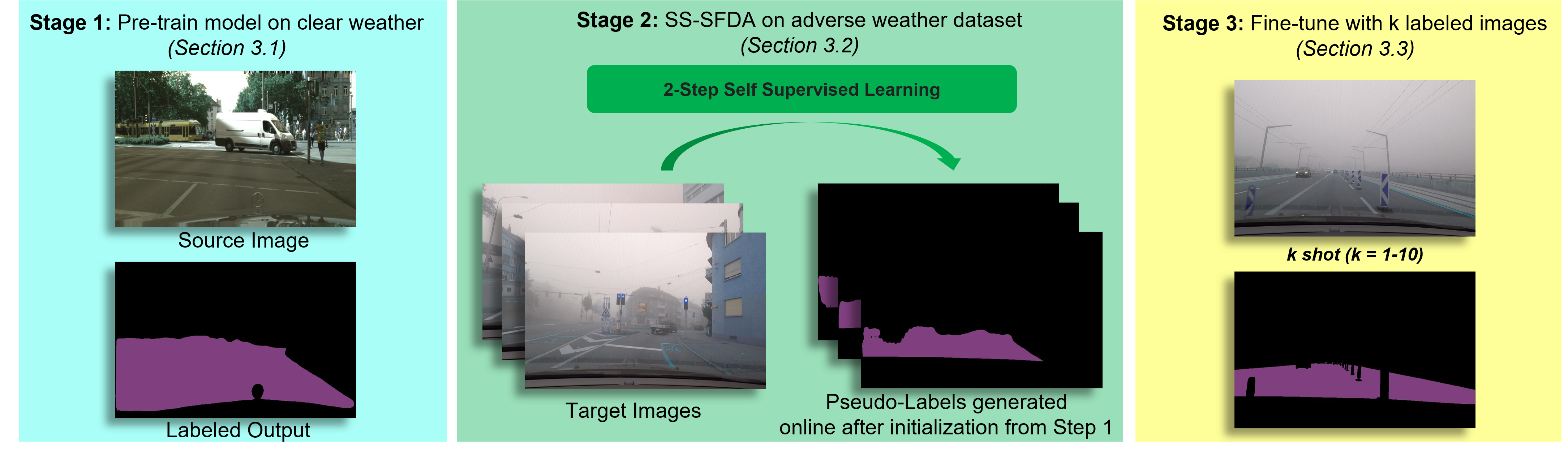
Overview of SS-SFDA: In stage 1, our model is pre-trained on a clear weather source dataset. In stage 2, our model is initialized with the pre-trained model from stage 1 and trained using our self-supervised algorithm, SS-SFDA, on the unlabeled adverse weather dataset. For heterogeneous weather datasets, we perform additional refinement steps based on model distillation (stage 3)
We present a novel approach for unsupervised road segmentation in adverse weather conditions such as rain or fog. This includes a new algorithm for source-free domain adaptation (SFDA) using self-supervised learning. Moreover, our approach uses several techniques to address various challenges in SFDA and improve performance, including online generation of pseudo-labels and self-attention as well as use of curriculum learning, entropy minimization and model distillation. We have evaluated the performance on 6 datasets corresponding to real and synthetic adverse weather conditions. Our method outperforms all prior works on unsupervised road segmentation and SFDA by at least 10.26%, and improves the training time by 18−180×. Moreover, our self-supervised algorithm exhibits similar accuracy performance in terms of mIOU score as compared to prior supervised methods.
Please cite our work if you found it useful,
@inproceedings{kothandaraman2021ss,
  title={SS-SFDA: Self-supervised source-free domain adaptation for road segmentation in hazardous environments},
  author={Kothandaraman, Divya and Chandra, Rohan and Manocha, Dinesh},
  booktitle={Proceedings of the IEEE/CVF International Conference on Computer Vision},
  pages={3049--3059},
  year={2021}
}